Working Woods Scotland – All You Need To Know
Article by ex course organiser, Catriona Birley, published in the Reforesting Scotland journal, issue 65 (2022).
“The Scottish hardwood industry is growing, and skills and contacts are key”, explains Kitty Birley
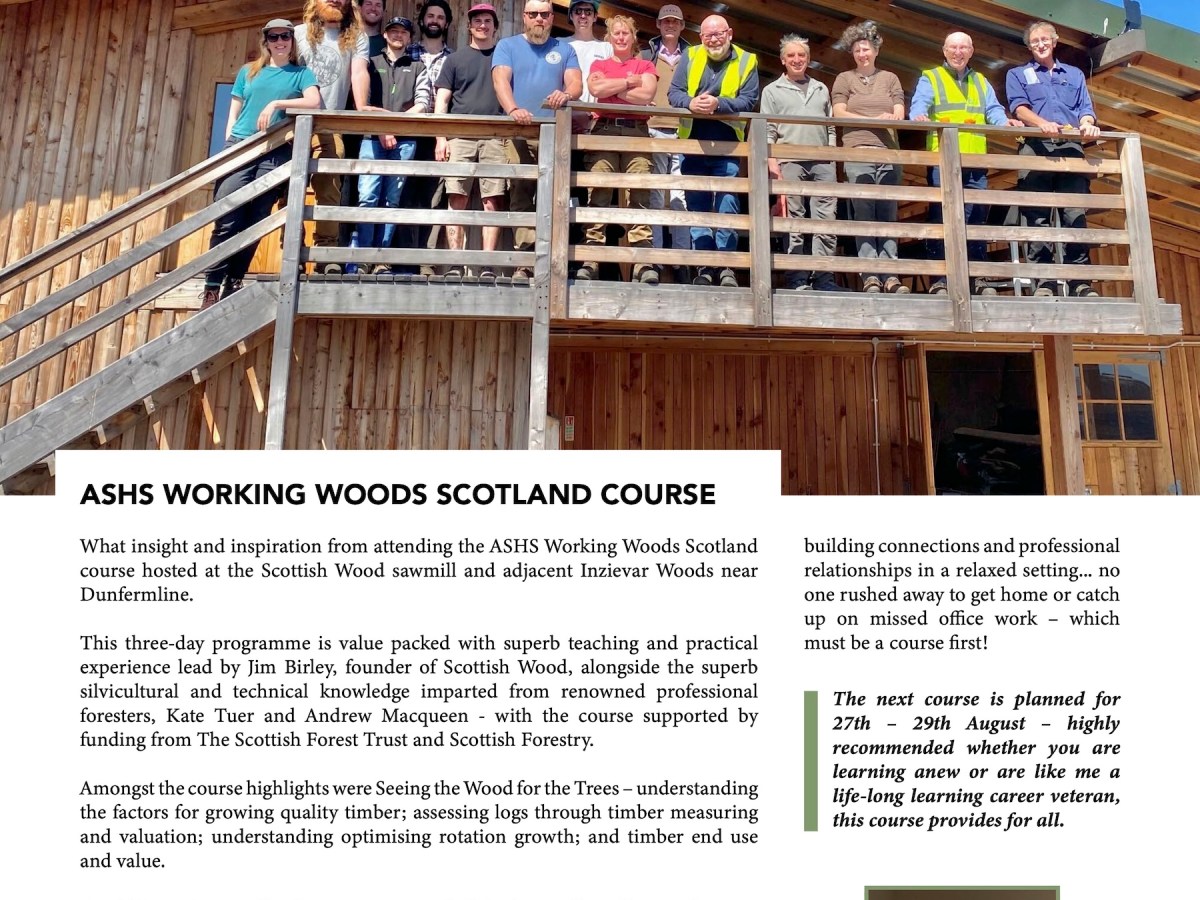
After two Covid-19 postponements, the Association of Scottish Hardwood Sawmillers (ASHS) was finally able to deliver its very first Working Woods Scotland course in October 2021. And it was a great success… thoroughly enjoyed by both participants and trainers alike.
Hardwood processing, and the growing of broadleaved trees for timber, is still niche in the forestry and timber sector, which is geared more towards conifers and softwood timber. As a result, the growing hardwood timber industry in Scotland has been built on mutual collaboration and peer-assisted learning. This has been helped by the creation of member bodies such as ASHS, which encourages the distribution of information and aid between members. One of the consequences of collaboration and peer-assisted learning is that your success in the hardwood sector is often dependent on your industry contacts. This is where educational and networking opportunities such as the Working Woods Scotland course come in.
Modelled on the popular Woodland to Workshop course run by Woodland Heritage in England, Working Woods Scotland was adapted to better suit a Scottish context and was designed to bring people together from across the Scottish hardwood industry—from foresters to furniture makers and everything in between—and provide teaching on the full circle of hardwood production from leading experts within the industry.
The course
Developed, organised, and hosted by ASHS, the training was spearheaded by long-time ASHS member Gavin Munro, with his wealth of knowledge and experience in the hardwood sector and running the Woodland to Workshop course in England. Backing up Gavin was a team of trainers with specialist knowledge on broadleaved forestry (Rick Worrell), hardwood processing (Jim Birley), and the production and marketing of timber products (Paul Hodgekiss).
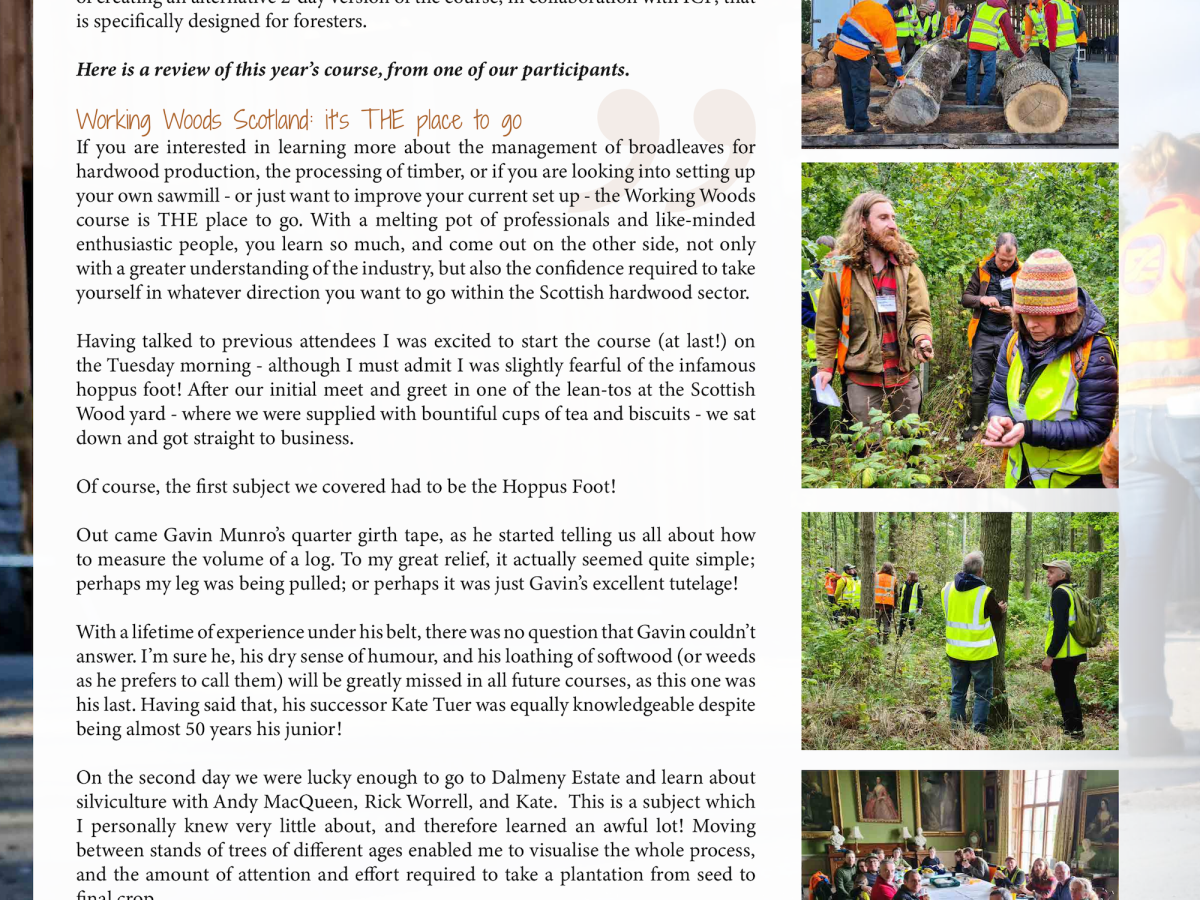
Day 1 was spent on grading hardwood logs and standing trees at Scottish Wood’s sawmill, with trainers Gavin Munro and Jim Birley, and a guest lecture from Paul Hodgekiss. Under the sharp eye and even sharper wit of Gavin Munro, the trainees were coached on the intricacies of grading and valuing hardwood timber and standing trees. This included a crash course on the Hoppus foot, a measure of volume from log to converted timber accounting for loss—a skill which the trainees were careful not to forget, as Gavin was apt to whip out his well-worn Hoppus foot booklet (published before you were born) and pass it to the nearest unsuspecting course member to calculate the volume of the nearest ‘butt’.
Later, Paul Hodgekiss stepped in to teach about the different markets and uses for hardwood timbers, with special attention paid towards the benefits of the ‘imperfections’ typically found in Scottish hardwoods. A consequence of this was that every time Gavin came across a tree that he deemed to be of poor-quality timber he would quip, “Well, I’m sure Paul would find a use for it”. One person’s trash is another person’s treasure, and that is no less true for hardwood timber!
Day 2 saw a return to the roots (literally) of forestry, with Rick Worrell whisking the trainees off to Dalmeny Estate to go over forest management practices for growing broadleaves for timber with assistance from Neil Atkinson (Forest Manager at Dalmeny Estate). Neil stepped in to pick up the reins from Kate Tuer, who tested positive for Covid-19.
Rick kicked off the day with a deep dive straight into the earth, explaining what to look for in good soil for growing hardwoods. He worked up from there, making use of the diversity in ages and quality between the different hardwood stands to demonstrate good planting and aftercare practices for hardwood production. Neil was able to provide more in-depth information on the planting practices at Dalmeny Estate, the issues they have encountered and how they overcame these issues.
Day 3 focused on hardwood processing, and a return to the sawmill to learn about sawmilling and kilning processes, as well as how to value your timber. The group saw the mill in action and toured the well-stocked timber showrooms that Scottish Wood has to offer. However, they were also set to task… measuring and valuing a range of logs both before and after milling. After a busy day of doing half of Jim’s work for him, the group got to retire to the classroom to learn about the kilning process for different hardwoods and hardwood pricing to round off the course.
The participants
The course had no shortage of applicants, and the diversity of the syllabus attracted both new and old hands within the hardwood sector. The course content, while excellent and diverse, was only part of what the course was designed for; the second goal of the course was to provide a platform for people from across the hardwood sector to get to know and learn from each other and the range of expertise and experience on offer.
Participants were deliberately selected to give a wide spread of experience and occupational backgrounds. Networking and collaboration were encouraged throughout, with an emphasis on interactive group working and communal evening meals. The meals were a highlight, and not just because of the free food or Gavin’s jokes, but because they provided the chance for the group to relax alongside the trainers and really get into the uses of the Hoppus foot—such as measuring up Gavin for his coffin (his words, not mine!).
“The Working Woods Scotland course brought together an incredible range and depth of knowledge, experience, wisdom and inspiration—and some excellent one-liners. Both the trainers and fellow participants had diverse backgrounds, and it was fascinating to learn from everyone. The balance was just right between covering a broad range of topics in a way that was accessible, whilst also delving into technical aspects. It all ran seamlessly, and has given me invaluable new information, insights, and friendships.”
Ellinor Dobie, Abbey Timber, Sawmiller
“The standout strength of the course was the variety of backgrounds and skill sets in both the tutors and the attendees. We were guided by true experts through each part of the process, right from choosing the best seed all the way to a finished piece of furniture. This really consolidated the idea that to get the best out of any tree, everyone in the chain needs to play their part, however small, which in turn creates the best value and the means to support as many livelihoods as possible. I wouldn’t hesitate in recommending the course to anyone with an interest in growing or working with Scottish hardwoods.”
Andrew Macqueen, AM Silviculture, All Forest Management
All in all, the course was a great success, with reviews from the participants commenting on the high quality of teaching provided as well as the social aspect of the three days, and many trainees feeding back how the course had helped them develop valuable friendships within the hardwood sector.
“It’s been a tremendous experience, proving to be very educational and informative. Enjoying the company of a diverse, although kindred-spirited, group of participants who became like family whilst being taught by passionate and inspiring speakers.”
Gwen Raes, Woodland Trust Estate Ranger at Glen Finglas
“Gavin, Rick and Jim were together masters of their fields, I could not imagine better teachers. Several friends were made on this course, and I came away full of inspiration and enthusiasm for our potential as one of Scotland’s working woodlands.”
Amos Higgins, FLS and Community Woodlands Forest Manager
The current climate crisis has shone a spotlight on woodlands and forests across the globe, and proper management of these vital habitats is paramount to our chances of reducing the impact of global warming. The hardwood sector, while small, is an important factor in our response to climate change, and collaboration is crucial to our understanding and ultimately our success in responding to the new challenges posed by the current conditions. With this in mind, and after reading those glowing reviews, I look forward to seeing your applications for Working Woods Scotland 2022!
Kitty Birley is the Environmental Project Officer at Scottish Wood, and acting Coordinator of ASHS.